
Sales Action Plans: How to Build One That Works
Learn how to write sales action plans with clear goals, owners, timelines, activities and measurable outcomes, plus a template and a review routine.
It's three weeks into the quarter, the forecast call is running long, and the same three deals get discussed for the fourth week in a row. Nobody can say which activity last month produced the proposal sitting in legal. The target is clear. The work that gets you there isn't written down anywhere.
A revenue target tells you the score after the game ends. A sales action plan tells each person what to do on Monday, what counts as finished, and when someone checks. That difference decides whether a quarter is recoverable in week six or only diagnosable in week twelve.
What follows is the version I'd give a manager who wants one page they can inspect every week: the fields, worked numbers, the failures that kill plans in month two, and the review habit that keeps one alive.
Table of Contents
- Why a Sales Action Plan Beats a Revenue Target Alone
- Sales Action Plan Template, Field by Field
- Build the Plan and Avoid Its Common Failures
- Measurable Outcomes That Predict Revenue
- How AI-Mediated Buyer Research Changes the Plan
- Keep the Plan in Your CRM and Review It Weekly
- Confirm Your First Plan This Week
Why a Sales Action Plan Beats a Revenue Target Alone
A team lands at 80% of its quarterly number and nobody can explain the shortfall. Next quarter the same reps run the same calls, and the result drops again. Nothing in the system recorded what produced the first result, so nothing can be repeated or corrected.
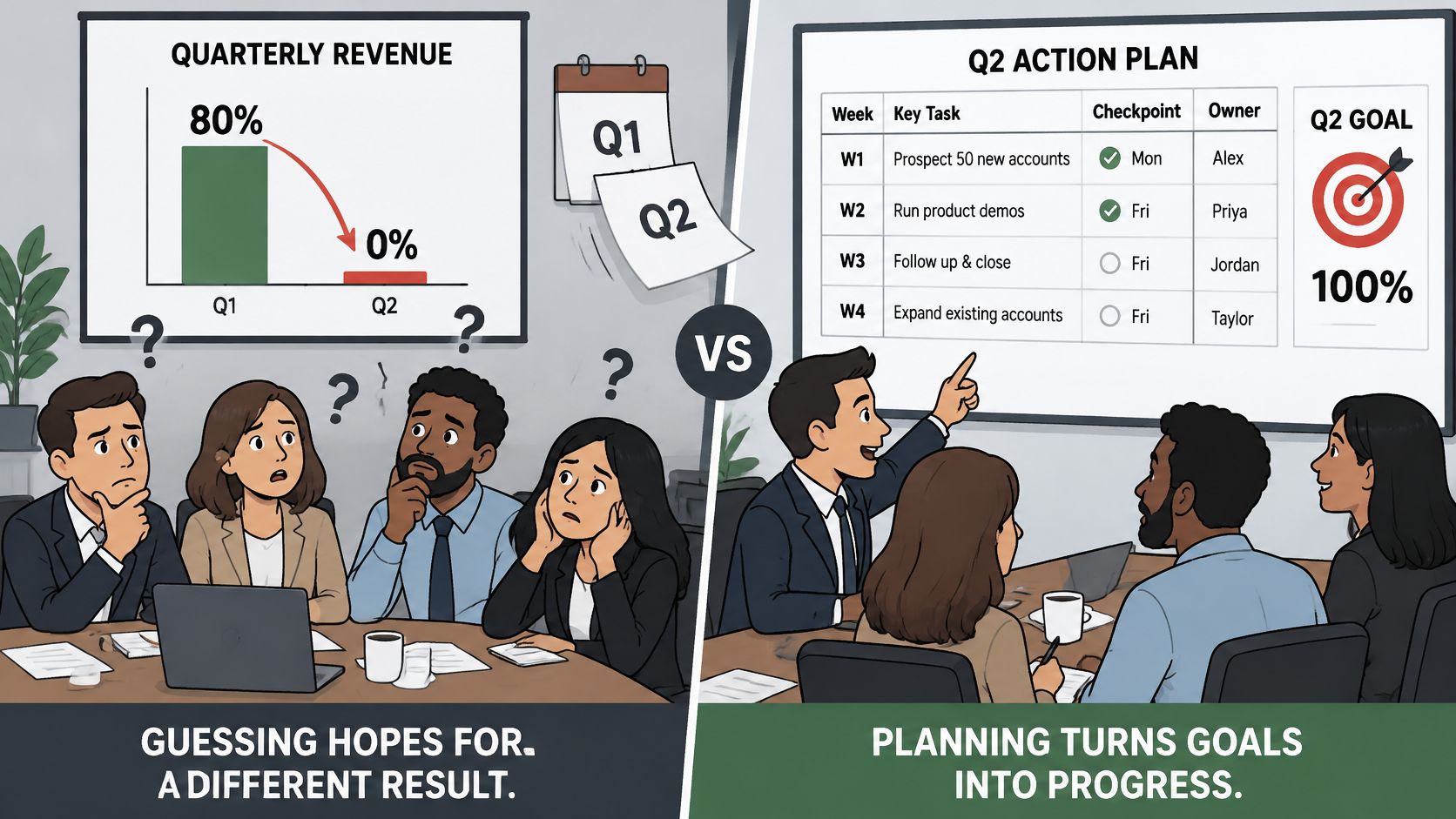
A target alone can't fix that, because it only reports the outcome. Salesforce describes sales action plans as a way to create accountability and visibility across account team members, with tasks and events attached to accounts, opportunities, leads, contacts and campaigns. The point is a shared record of the controllable work, not a bigger number on a slide.
The distinction that matters is ownership. A to-do list says "follow up with enterprise accounts." A plan says Priya owns 12 discovery meetings in the mid-market segment by August 1, and the CRM stage change proves it happened.
Plans earn their keep in four situations: rebuilding a pipeline that thinned out last quarter, coaching reps who log activity but never advance deals, coordinating sales with marketing and revenue operations, and launching a segment where no baseline exists yet.
Check this quarter's target now. Pick any number in it and ask which single activity, owned by which named person, produces it. If the answer takes more than ten seconds, you have a target, not a plan.
Sales Action Plan Template, Field by Field
Copy this into a spreadsheet or a CRM object. Seven fields, no more, until the team updates them daily without being asked.
| Field | What to write | Example |
|---|---|---|
| Goal | One number tied to revenue or pipeline | $600K in new bookings by September 30 |
| Owner | One named person accountable for the result | Priya, sales manager |
| Timeline | Start date, checkpoint dates and end date | Jul 1 start, Jul 15 and Aug 1 checkpoints, Sep 30 end |
| Activities | Specific actions with counts | 40 outbound calls and 5 new accounts contacted per rep each week |
| Measurable outcome | Lagging result paired with leading indicators and targets | 8 qualified opportunities by Aug 1 |
| Evidence | Where completion is recorded | CRM activity logs and opportunity stage changes |
| Review date | When the plan is inspected and by whom | Weekly 30-minute review with sales manager and rep |
The goal is one number, not an ambition. "Grow enterprise" is not a goal. The owner is a person, because a line shared between two people is a line nobody defends. The timeline holds three dates rather than one, so the plan can fail early enough to fix.
Activities are counted, not described: calls, new accounts contacted, discovery meetings held, mutual action plans sent. Measurable outcome pairs the result you want with the numbers that predict it, so a quiet week shows up as a gap in opportunities rather than a surprise at quarter end. Evidence answers the question every rep asks: where does this live? If the answer is a separate tracker, the plan is already dead.
The quarterly plan sits under a wider set of plays, and the parts of a GTM playbook is the right place to sort out which play this quarter's plan is executing.
Here's the test. On Friday, can a manager tell from these fields alone whether the plan is on track? If not, the template needs a sharper number, not another row.
Build the Plan and Avoid Its Common Failures
Plans die in month two, not at the kickoff. The build below stays deliberately small, because a plan a rep can't update in two minutes a day won't survive a busy week.
The six steps
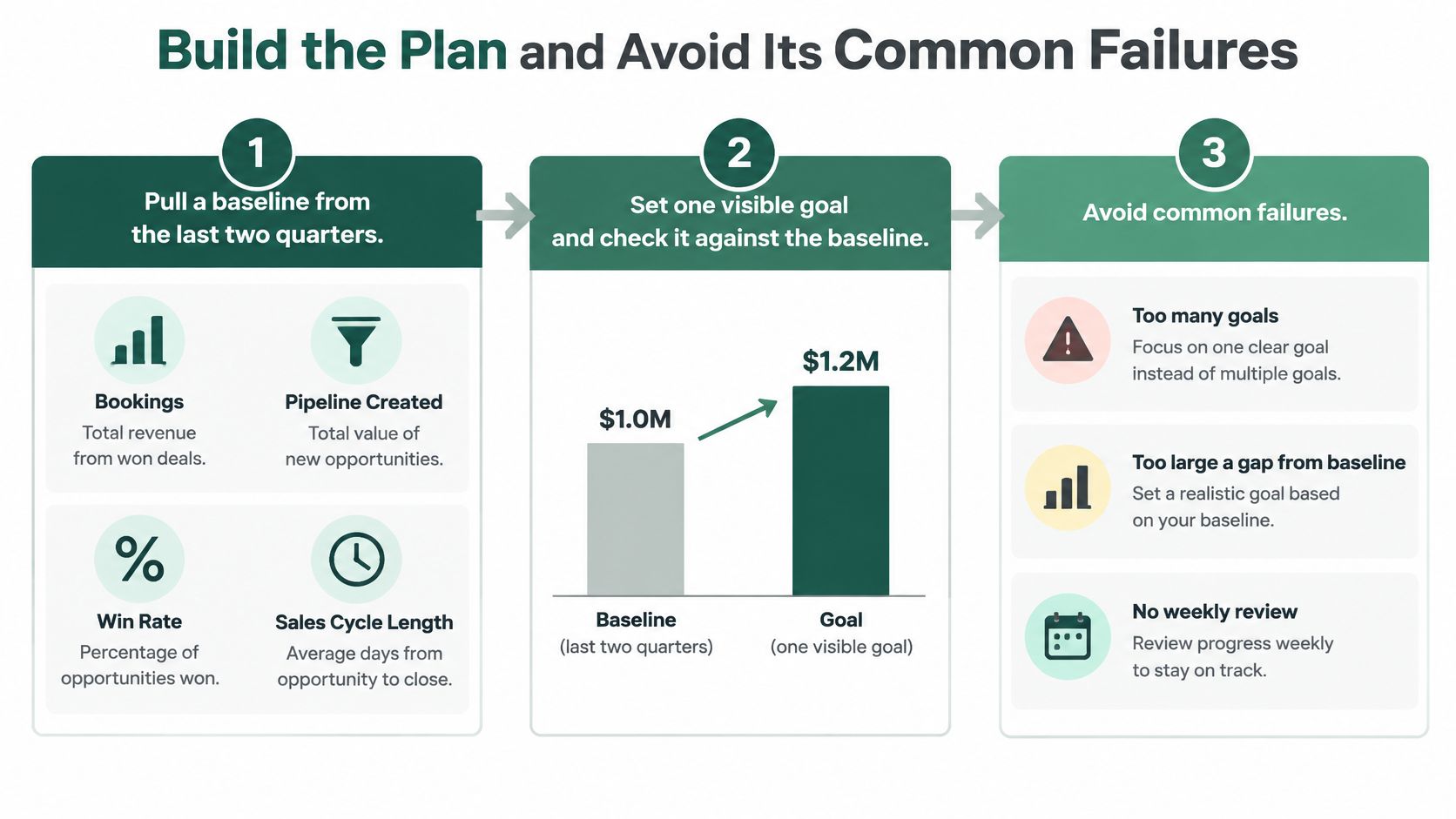
- Pull a baseline from the last two quarters. Bookings, pipeline created, win rate and sales cycle length. Four numbers, taken from the CRM rather than memory. Without them you're guessing at whether a target is ambitious or fiction.
- Set one visible goal and check it against the baseline. A goal 15% above the trailing average is a stretch. A goal 60% above it needs a different play or another rep, not more effort from the same team.
- Break the goal into leading indicators. Pipeline coverage of about 3x, a fixed number of new qualified opportunities per rep per month, and a next-step date on every open deal. These are the numbers a rep controls on a Tuesday.
- Assign one owner per activity line. Not per team, not per pod. When two names sit on a line, both assume the other is doing it.
- Set a start date, a two-week checkpoint and a close, and block them on calendars now. A checkpoint that exists only in the plan document will be rescheduled by the first busy week.
- Book the review meeting and agree in advance what changes if a checkpoint is missed. Cutting a play, adding coaching, or moving the target accounts. Deciding this before the miss removes the negotiation.
Where plans break
- The goal copied from last year with no baseline. Fix it by resetting from two quarters of actuals, even if the number comes out lower than the board expects.
- Too many activities, so reps skip most of them. Three to five counted activities is the ceiling. A rep with eleven daily actions tracks none of them.
- Two people sharing one owner line. Name one owner and put the other in a supporting role. The ownership field is the first thing to check, because a plan without a named owner rarely survives its first review.
- Counting messages sent rather than replies earned. Buyers research before they answer, so a sent email proves effort and nothing else. Measure the response, the meeting, or the stage change instead.
The warning signs arrive before the miss does: no checkpoint notes, activity counts untouched since the day they were set, a forecast that moves every week in the same direction. Any one of those means the plan has become paperwork.
Here's the operating rhythm teams settle into once the fields are in place.
A first plan holds one goal, three to five activities, one owner per line and one review date. Resist adding a second goal until the first one has survived a checkpoint.
Measurable Outcomes That Predict Revenue
A bookings target tells you where to finish. It says nothing about whether you're on pace. Xactly's sales statistics collection reports that only 9% of companies forecast revenue within 5% of actual results, while 60% miss forecasts by more than 10%. A plan that tracks only the revenue number finds out which group it belongs to in the final week of the quarter.
The fix is to split every target into two layers. Lagging outcomes are bookings, revenue and win rate. Leading indicators are qualified opportunities created, meetings held, stage progression and next-step dates set. The standing rule: each lagging target needs at least two leading indicators the rep controls.
Work the arithmetic once
Take a $600K bookings target at a 25% win rate. That needs $2.4M of qualified pipeline. At a $40K average deal size, the quarter requires 60 qualified opportunities, roughly five a week across a five-rep team. Now the weekly review has something concrete to inspect: did we create five qualified opportunities this week, and if we fell short, which activity line is behind.
Run that arithmetic once per quarter and the review question writes itself. Skip it and every check-in collapses into opinions about pipeline that nobody can settle.
Three tests for any measure you add. The owner can influence it. It's recorded somewhere a manager can open. It has a threshold that triggers a decision. A measure that fails any of the three becomes commentary, and commentary doesn't survive a busy week.
Working rule: every lagging number gets at least two leading indicators beneath it. Fewer than that and the target is a hope with a date attached.
If a meaningful share of pipeline comes from social outbound, measuring results from X outreach deserves a place beside the CRM numbers rather than a separate report nobody opens. And if you want the wider frame for how these measures feed a revenue engine, a RevOps perspective on metrics covers the reporting layer that sits above a single quarter.
Quota attainment across sales teams often falls short of targets for long stretches, which is why plans get revised at checkpoints rather than at quarter end. A plan built on an optimistic attainment assumption shows that assumption at the first checkpoint, and that's when the leading indicators earn their place: they tell you whether the miss is a pacing problem you can correct or a pipeline problem the quarter can't recover from.
How AI-Mediated Buyer Research Changes the Plan
Most plans still assume the seller opens the conversation. Buyers have already moved. The 2025 G2 Buyer Behavior Report finds buyers skipping steps, shrinking vendor shortlists and using AI for early research, with two-thirds preferring to engage sales only after conducting their own research.
That changes which activities deserve a line in the plan.
- Add a buyer-facing asset count. Comparison pages, ROI calculators and implementation guides shipped or refreshed each week. It's an activity with an owner and a number, like any other.
- Track buyer-initiated conversations as a leading indicator. Inbound demo requests and shortlist mentions, expressed as a share of new opportunities, tell you whether the proof you publish is working before a rep ever speaks.
- Time stage entry from the buyer's side. If 40% of a quarter's opportunities arrive after the buyer has already shortlisted you, the plan counts shortlist presence as a checkpoint instead of crediting the outbound call that came after.
A plan that rewards only calls placed will look healthy while the shortlist fills up without you. Review this line monthly, because buyer research habits move faster than quarterly planning cycles.
Keep the Plan in Your CRM and Review It Weekly
A plan living in a spreadsheet is a document of intentions. Bain's 2025 survey of more than 1,200 senior commercial executives across 18 industries found that 70% of companies fail to integrate sales plays effectively into CRM and revenue-technology tools, and only about 20% realize the full value of their sales plays, according to Bain & Company's survey release. The strategy usually isn't the problem. The systems design is.
Four setup moves carry most of the value.
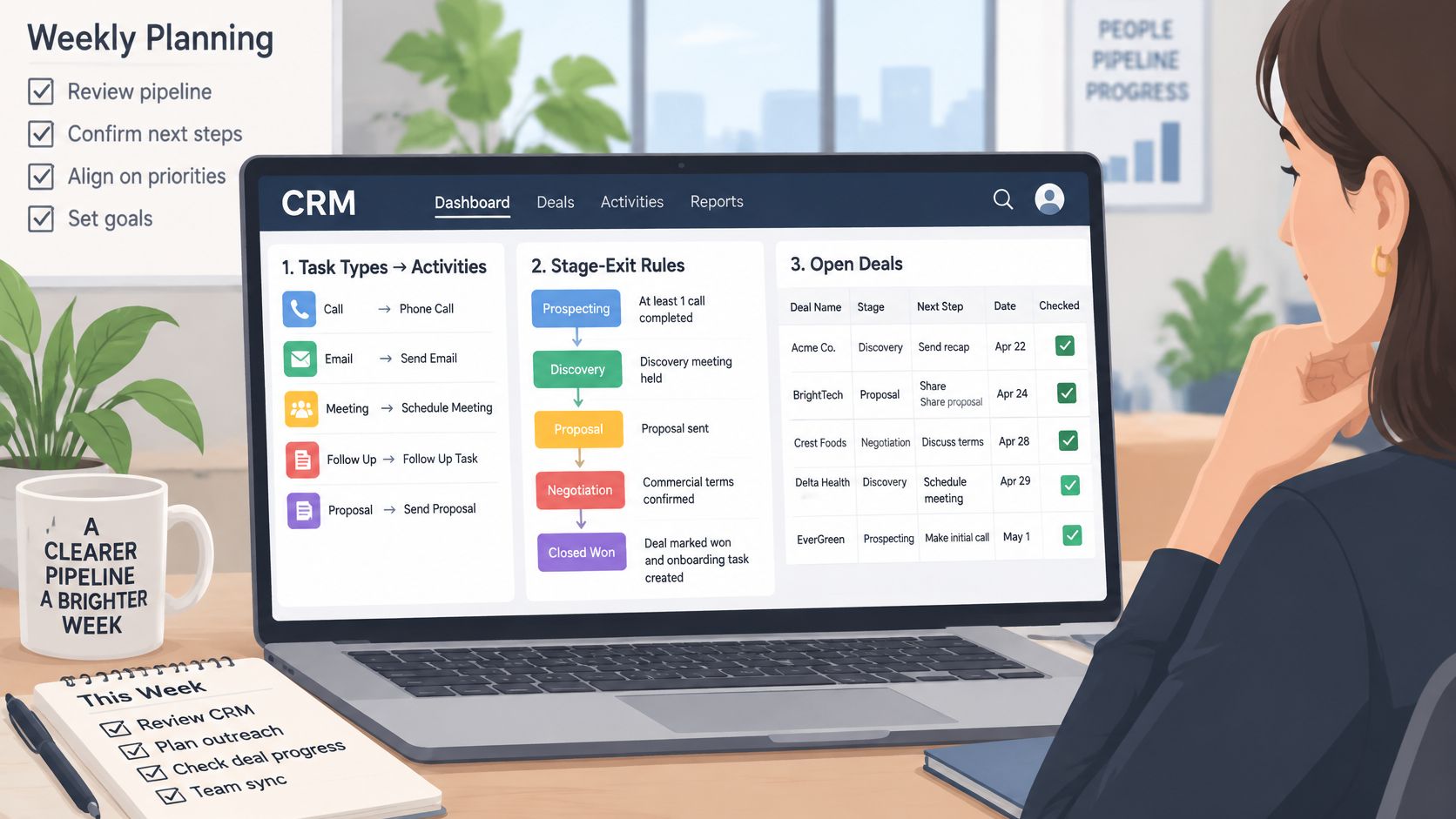
- Map each activity to a task type in the CRM. Calls, meetings, emails and mutual action plans each get their own type so counts are comparable across reps.
- Define one stage-exit rule per stage. A deal leaves discovery when a next step is booked with a named stakeholder, not when the rep feels good about the call.
- Require a next-step date on every open deal. No date, no forecast category. This one field exposes stalled pipeline faster than any dashboard.
- Build one dashboard comparing planned activity with actual. One screen, weekly, no exports.
Separate volume from progress. A discovery call counts when the deal advances or a next step gets booked; otherwise it's a conversation. Picture a manager with twelve reps who moves the plan out of a shared spreadsheet into a single dashboard and stops counting the same activity twice. The hour saved per week is real, and so is the argument the dashboard settles.
Some work should stay manual. Strategic accounts with multi-stakeholder buying committees depend on context a dropdown can't hold, so keep those as written notes linked to the plan rather than forcing them into stage rules. If picking a CRM is still open, sales CRM rankings by KeenVerdict are worth reading before you commit, since stage models differ more than vendors admit. For teams restructuring who owns the reporting, the revenue operations consultant role explains where that work should sit.
The review rhythm the setup supports
| Cadence | What to inspect | Decision to make |
|---|---|---|
| Daily | Activities logged against the plan | Reassign blocked tasks the same day |
| Weekly | Leading indicators against target | Adjust activity volume or target accounts |
| Monthly | Stage conversion rates and forecast accuracy | Change the play or the segment |
| Quarterly | Outcome against goal and each owner's results | Keep, rewrite or retire the plan |
If reps update the plan only before a review, cut fields until updates happen daily. A plan refreshed for meetings is administration, not management.
Confirm Your First Plan This Week
Three things finish before Friday. Write the goal number down, pulled from two quarters of actuals. Name one owner against it, using a person's name rather than a team's. Put the first review on the calendar with a date and a time, not "early next month."
The first checkpoint teaches more than the final result, because it shows whether the leading indicators moved while there was still time to change the play. A missed checkpoint handled in week two is information. A missed quarter handled in week thirteen is a post-mortem.
If nobody on the team can run a weekly inspection, a fractional leader is one option among several, alongside an internal sales manager or a peer review with another team's lead. Revenue Nomad matches each client with a pre-vetted Fractional Sales VP through a three-step process of matching, discovery and sales execution.
Before you close this tab: goal number written, owner named, first review booked. If one of the three is missing, the plan is still a target.
Revenue Nomad connects companies with fractional sales leaders who build and run exactly the kind of operating plan described here, from the baseline through the weekly inspection, so a target stops being a wish and starts being a schedule. If your team has a number but no activity plan behind it, visit Revenue Nomad to see how matching works and what a fractional sales leader would take on in your first quarter.